

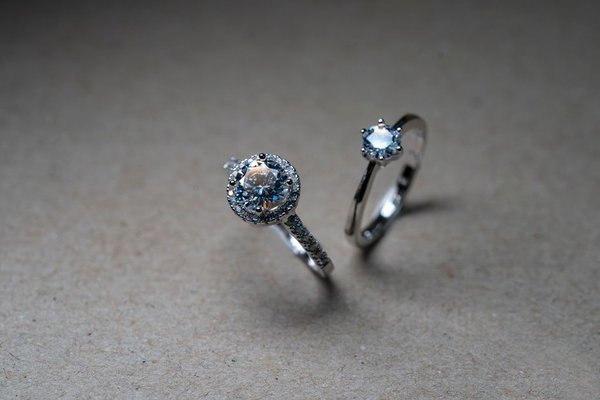
Choosing between a solitaire and a halo engagement ring is less about finding a universally “better” setting and more about deciding what you want the ring to emphasise. A solitaire puts nearly all the visual attention on one centre stone, while a halo surrounds that stone with smaller diamonds or gemstones to create extra sparkle and a larger overall look. Both are enduring choices, but they suit different priorities in appearance, maintenance, budget and everyday wear.
Solitaire vs halo engagement ring: the key difference
A solitaire ring usually features a single centre stone held by prongs, a bezel or another simple setting. Because there are few competing details, the eye goes straight to the shape, cut and proportions of the centre stone. This makes the solitaire especially appealing if you love a clean, classic look or want an oval, emerald, pear or marquise stone to stand on its own.
A halo ring places a circle of smaller stones around the centre. Those surrounding stones add brightness and visual width. From a distance, a well-proportioned halo can make the centre appear larger than it would in a solitaire setting, although the actual centre-stone carat weight does not change.
Which style gives you more sparkle?
If maximum sparkle is high on your list, the halo usually has the advantage. More exposed diamond surface area creates more points of light, which can be especially noticeable under evening lighting or in photographs. A solitaire offers a different effect: cleaner and more concentrated, with the centre stone as the focus.
So when comparing halo vs solitaire designs, think about the type of sparkle you prefer. A halo feels brighter and more decorative, while a solitaire tends to look crisp, refined and visually calm.
How each setting affects the centre stone
The solitaire is often the stronger choice when the centre stone itself is the star. Its outline and facet pattern remain easy to see, which is particularly appealing with distinctive shapes or step-cut diamonds such as emerald cuts. Minimal surrounding detail can also help coloured gemstones or unusual centre stones feel more individual.
A halo changes the composition. The centre remains important, but it becomes part of a broader design. A closely matched halo can visually enlarge a smaller centre stone and give the ring more finger coverage. If the halo is too heavy for the centre, however, it may compete with the stone rather than frame it.
Budget: where your money goes
There is no automatic rule that a solitaire is always cheaper than a halo. Final price depends on the centre stone, metal, craftsmanship and accent stones. What differs is how the budget is distributed. With a solitaire, more of the spend is typically concentrated in the centre stone. With a halo, part of the budget goes toward the smaller surrounding stones and the extra setting work.
Consider two shoppers with the same total budget. One may prefer a high-quality oval centre diamond in a simple solitaire because the centre stone matters most. The other may choose a slightly smaller oval with a delicate halo because finger coverage and sparkle matter more. Comparing those two approaches side by side is often more useful than looking at carat weight alone.
Maintenance and everyday wear
A solitaire generally has fewer small stones and therefore fewer components to inspect. That can make routine cleaning and maintenance simpler. Prongs still need periodic checking, but there are fewer accent stones that can loosen.
A halo contains multiple small stones, each secured by tiny beads or prongs. Good craftsmanship matters, but the design naturally has more parts that may need attention. Dirt, lotion and soap residue can also collect around closely set stones, so regular cleaning helps keep the halo bright.
If you work frequently with your hands or prefer low-maintenance jewellery, compare the side profile as carefully as the front view. A lower setting may feel more practical than a tall design that catches on clothing.
Which looks more timeless?
The solitaire is often considered the most pared-back and adaptable engagement ring style. Its simplicity works with many wedding bands and is less dependent on decorative details. But halo rings are not automatically trendy or short-lived. A closely fitted halo can look classic, while a larger halo makes a stronger statement.
If long-term appeal matters, focus on whether you genuinely love the ring’s proportions and silhouette rather than choosing based on what happens to be fashionable.
Wedding band pairing and styling flexibility
A classic solitaire often pairs easily with a straight wedding band. Some halo designs also sit flush with a straight band, while others have baskets or low-set centres that may require a curved or fitted wedding ring. Try the engagement ring with several band shapes before buying, even if the wedding is still some time away.
Natural topics to explore alongside this decision include an engagement ring settings guide, choosing a wedding band, and comparing diamond shapes.
How to choose between a solitaire and halo
A useful engagement ring style comparison starts with priorities rather than labels. Choose a solitaire if you want a clean focal point, strong emphasis on the centre stone, easy styling and relatively straightforward upkeep. Choose a halo if you want extra sparkle, more finger coverage, a larger visual footprint or a more detailed look.
When trying rings on, view them straight on, from the side and next to a potential wedding band. Then look at them in both bright showroom lighting and softer natural light. This practical test can reveal whether you genuinely prefer the setting or are mainly responding to intense display lighting.
FAQ
Does a halo make an engagement ring look bigger?
Yes. A halo can make the overall face-up appearance of a ring look larger because the surrounding stones add width around the centre. The centre stone itself does not become larger, but the combined outline creates more visual presence.
Is a solitaire engagement ring easier to maintain?
Usually, yes. A solitaire has fewer small accent stones and fewer tiny settings to inspect. It still needs regular cleaning and occasional professional checks, particularly around the centre-stone prongs.
Can a halo ring look timeless?
Yes. A delicate, well-proportioned halo can have a classic appearance, especially when the surrounding stones complement rather than overpower the centre. Timelessness depends more on balance and personal taste than on the presence of a halo itself.
Which is better for a smaller centre diamond?
If your priority is making the ring look larger overall, a halo can be effective. If you prefer a clean, understated look and want the centre diamond’s shape to remain the main focus, a solitaire may still be the better choice.
Final thoughts
The best solitaire vs halo engagement ring choice comes down to what you want to notice first when you look at your hand. A solitaire celebrates one centre stone with minimal distraction; a halo builds a brighter, broader frame around it. Compare both on your own finger, consider maintenance and wedding-band pairing, and judge the ring as a complete design rather than by carat weight alone. The right setting is the one whose tradeoffs fit the way you actually plan to wear and enjoy the ring.
